


You Never Know What You'll Get to DO in Family Medicine


Thirty years ago, if you had asked me what I wanted to be when I grew up, I would have had an easy answer:
I wanted to be a professional golfer.
I played competitive golf through high school and college. I watched the LPGA on television week after week. I knew the players, followed the tournaments, and admired the women who were building the game and creating opportunities for the generations coming behind them.
Life, of course, had other plans.
I did not become a professional golfer. I became something I am incredibly proud to be, an osteopathic family physician.
And last month, those two parts of my life collided in a way I never could have imagined.
A Different Kind of Golf Week

I had the opportunity to provide medical coverage for an LPGA Legends event here in Kentucky. I went into the week expecting my role to be fairly straightforward: be available to provide medical care for spectators, golfers, or anyone else who might need it.
What I did not expect was to spend several days feeling like the kid who used to sit in front of the television watching these women play golf.
The setting made it even more surreal.
I have attended U.S. Women’s Opens and Solheim Cups, where ropes separate spectators from players and enormous galleries follow the biggest names in the game. This was completely different. It was intimate. There were no massive crowds and very few barriers between the players and everyone around them.
Suddenly, women I had watched on television for years were simply...there.
I watched legends like Pat Bradley, Hollis Stacy, Juli Inkster, Annika Sörenstam, Michelle McGann, Angela Standford, and so many others play golf just a few feet away.
And then I got to play alongside some of them in the pro-am events.
For a lifelong golfer, it was incredible.
But somehow, golf wasn't even the most remarkable part of the week.
“Hi, I’m Jane.”
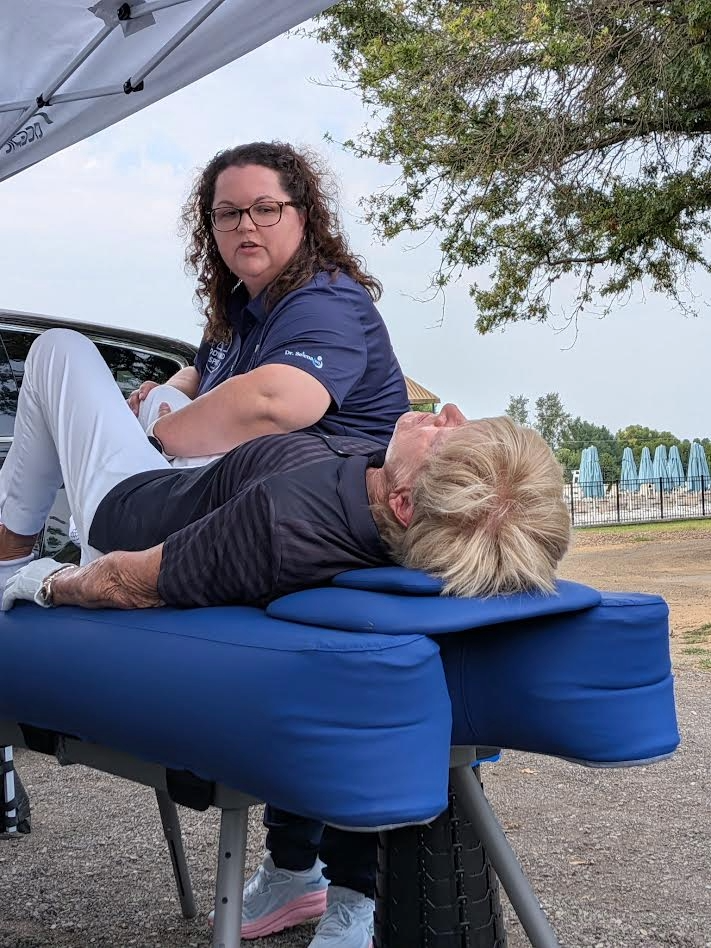
At one point, a woman walked up to me and said something along the lines of:
“Hi, I’m Jane. I heard you can help me with my leg.”
I smiled and politely introduced myself. Meanwhile, the internal conversation happening inside my head was something closer to:
"Oh. My. Gosh. You’re Jane Blalock. Thirty-five professional wins. A record 299 consecutive cuts made; a streak that stands as one of the most remarkable records in professional golf. A businesswoman. A champion of women's golf. A woman whose career helped pave the way for generations of female golfers." She did not need to introduce herself to me.
But she did. And she was kind, gracious, and incredibly generous in our interactions.
Then came the part that I still have trouble believing. I got to treat her using osteopathic manipulation.
Not only her, but other golfers as well.
These were athletes whose swings I had watched growing up, and suddenly I was using my hands, my training, and the osteopathic principles I believe so deeply in to help them move and feel better.
Even more meaningful was hearing afterward that the treatment helped, that they felt better, played better, and believed the treatment contributed to how they performed not only that weekend, but into the following week.
There are moments in medicine when you know you are exactly where you are supposed to be.
This was one of mine.
This Is Family Medicine
One of the reasons I love family medicine is that our skill set can take us almost anywhere.
Family physicians take care of babies and grandparents. We work in hospitals, clinics, emergency departments, nursing facilities, schools, sporting events and people's homes. We care for entire families and entire communities.
We manage chronic disease. We diagnose the undifferentiated patient. We treat injuries. We perform procedures. We provide preventive care. We care for athletes.
And when you combine that broad training with osteopathic medicine and OMT, you carry another remarkable tool with you everywhere you go:
Your hands.
I didn't need an operating room or an expensive piece of equipment that week. I needed an exam table, my knowledge of anatomy and biomechanics, and the skills I have spent years developing as an osteopathic physician.

That is something I wish more medical students understood about osteopathic medicine.
OMT isn't simply something you learn for a practical exam during medical school. It isn't a collection of techniques you memorize long enough to pass boards.
It is a clinical skill. And if you continue to develop it, you never know where it might take you.
Someday, apparently, it might even take you onto a golf course with your childhood heroes.
The Best Part Wasn't Mine
As extraordinary as the week was for me, my favorite part of the experience actually belonged to my daughter. She came along initially to help me. Then something happened.
She started to fall in love with golf.
She quickly made friends with Wendy Ward, Gail Graham and Elaine Crosby while we played pro-am rounds. She had opportunities to caddie in groups with Nancy Scranton, Ashli Bunch, Laura Davies and Trish Johnson. She was around accomplished collegiate golfers who may very well be the players we are watching on television in the years ahead.
Meanwhile, I spent much of the weekend completely giddy, trying to explain to her the magnitude of the women casually walking around us.
I asked her, "Do you understand who that is?"
Probably not. And maybe that was part of what made it so wonderful. To her, they weren't names from television broadcasts or golf history books. They were women who talked to her, encouraged her, joked with her, let her walk beside them and welcomed her into their world.
She got to see extraordinary female athletes not from behind a gallery rope, but up close.
She saw women who competed at the highest levels of their sport, built careers and businesses, advocated for women's golf, and created opportunities that did not exist for the generations before them. They paved the way. And now another little girl picked up a golf club because of them.
There is something beautifully full circle about that, too.
Be Osteopathic on Purpose
I talk frequently with medical students about the opportunities available in family medicine and osteopathic medicine. Sometimes students understandably focus on what specialty they are going to choose, where they will match, what their future practice will look like, or what their career trajectory is supposed to be. But medicine doesn't always follow a straight line. Neither does life.
Family medicine has allowed me to teach, lead, serve my community, care for patients across generations, build my own practice, advocate for changes in healthcare, and apparently, provide OMT to legendary professional golfers.
I certainly didn't have that last one on my career planning worksheet. And that may be the lesson. Your medical degree is not the destination. It is a tool that can open doors you don't even know exist yet.
If you are an osteopathic medical student, learn your osteopathic skills. Practice them. Become comfortable using your hands. Understand why we examine and treat the body the way we do. Don't leave that part of your education behind when you graduate.
And if you are considering family medicine, don't mistake breadth for limitation.
Breadth is opportunity.
There are very few specialties that allow you to say, “I can probably help with that,” in as many different places, for as many different people, as family medicine does.
Thirty years ago, I thought my dream was to become a professional golfer.
I didn't.
Instead, I became an osteopathic family physician.
And somehow, three decades later, osteopathic family medicine brought me back to the golf course, standing beside some of the women who inspired that childhood dream, with the opportunity to use my own unique skills to help them. Then I got to watch those same women inspire my daughter. I could never have planned that career path. But I wouldn't trade it for the one I imagined when I was a kid.
Sometimes our dreams don't disappear. They just find a different way to come full circle.
Be osteopathic on purpose. You never know where it might take you.


Comments